Featuring of traveling to Tibet but feeling overwhelmed by the quantum of exploration, trip permit, and planning that seems to be involved? solicitude no more, we've the most comprehensive Tibet trip companion before you go. Read below for everything you need to know including visa and permit instructions, charts, indigenous information.
I want to go to Tibet. stay Where is it?
Despite Tibet’s pervasiveness in popular imagination, many people are suitable to detect the area on a chart. What exactly is Tibet? And where is it? No, it is n’t an disturbing question. This detailed Tibet trip companion runner is the first thing you need to know!

Tibet is a cultural region whose physical location roughly corresponds with that of the Tibetan Plateau. Beyond the People’s Republic of China, Tibetan speaking peoples are there across the Himalayas in Bhutan, India, Nepal, and Pakistan. Today, the bulk of Tibetan cultural areas are part of the PRC. In addition to the Tibet Autonomous Region (TAR), there are 10 Tibetan Autonomous Prefectures located in the provinces of Qinghai, Gansu, Sichuan, and Yunnan.
Defining Tibet
Owing to the plateau’s immense diversity, coming up with a compact definition of Tibetan culture is a complicated issue. The Tibetan Plateau is home to countless ethnic groups, more than 100 languages, and more than 220 Tibetan dialects.
In English, the name, ‘Tibet’ derives from the ancient Chinese and Arabic names given to an empire founded by a powerful lineage of kings whose kingdom stretched, at its height, as far west as Pakistan and as far south as Nepal and whose bloodline reigned uninterrupted for over 1000 years. Many of our present day understandings and images of Tibet date back to Tibet’s imperial period; a time when the Tibetan Empire (7th-10th century AD) was, in fact, not the isolated kingdom of our imagination, but a dynamic, cultural melting pot. The seeds of language, writing, and religion planted during this time have continued to blossom for centuries, producing a people connected through, above all else, a unique Buddhist culture.
Emerging from humble origins as local tribe leaders in Lhasa’s Yarlung Valley, the Tibetan Kings gradually came to conquer and control much of the geographic feature we know today as ‘the Tibetan Plateau’ (the largest and highest geographical feature on the planet). In the process, they traded and skills, conquered and absorbed surrounding cultures, and adopted cultural knowledge from other powerful empires. Today, we often refer to ‘Tibet’ as the geo-cultural area conquered during the Golden Age of the Tibetan Empire, yet in the final years of the 10th century, internal struggles and religious persecution brought an end to one of Eurasia’s most impressive cultural kingdoms. In the years that followed, Buddhism experienced a massive revival, becoming the defining and distinguishing characteristic of ‘Tibetan Culture’. Read more Tibet travel guide to get all information how to visit Tibet.
China’s Administrative Division
The People’s Republic of China (PRC) is comprised of 22 provinces and five autonomous regions which are administered under the Chinese Communist Party’s system of democratic centralism. Chinese provinces are composed of prefectures which are in turn made up of counties, townships, and villages.
The Tibetan areas of the PRC are:
- Gannan Autonomous Tibetan Prefecture in Gansu Province
- Haibei Autonomous Tibetan Prefecture in Qinghai Province
- Huangnan Autonomous Tibetan Prefecture in Qinghai Province
- Hainan Autonomous Tibetan Prefecture in Qinghai Province
- Golog Autonomous Tibetan Prefecture in Qinghai Province
- Yushu Tibetan Autonomous Prefecture in Qinghai Province
- Haixi Mongol and Tibetan Autonomous Prefecture in Qinghai Province
- Aba Tibetan and Qiang Autonomous Prefecture in Sichuan
- Garze Tibetan Autonomous Prefecture in Sichuan
- Deqen Tibetan Autonomous Prefecture in Yunnan
- Xizang Tibet Autonomous Region
U-Tsang, Kham and Amdo Tibet Travel Guide: The Three Main Cultural Regions
The greater Tibetan cultural area can be roughly split into three main cultural and linguistic sub-cultures: U-Tsang (Central Tibet), Amdo, and Kham. Each area boasts its own unique cultural flavour, special local style of dress, dilect, and customs. Have a look!
Amdo Travel Guide
Amdo cultural areas are in southwestern Gansu, Qinghai, and northern Sichuan. Amdo is famous for it’s rolling plains, scholars, and for its leading role in Tibet’s Buddhist revival. Look into the best Amdo tour packages.
Travel Destinations in Amdo
- Amnye Machen (trek)
- Nyenpo Yurtse (Trek)
- Labrang Monastery
- Qinghai Lake (Lake Kokonor) (Hot! Qinghao Lake Day Tour)
- Traditional Thangka Painting in Rebkong (Tour)
Central Tibet Travel Guide (The Tibet Autonomous Region)
The area which you will see labeled ‘Tibet’ on a map is the Tibetan Autonomous Region (TAR), a province of The People’s Republic of China (PRC). This is the largest piece of cultural Tibet, the historic seat of the Tibetan Kings, and home to the iconic Potala Palace. It is famous for its sky high peaks, breathtaking views, and crystal clear, sacred lakes. The TAR is the heartland of Imperial Tibet and home to numerous important monasteries, castles, and monuments. It is known alternately as U-Tsang or Central Tibet. In ancient times, this area was comprised of two separate provinces: U and Tsang and the once powerful Kingdom of Zhangzhung (Ngari) in the far west—conquered by the 33rd Tibetan King during the 7th century.
Travel Destinations in the Tibet Autonomous Regions
- Lhasa and Beyond: Potala Palace, Jokhang Temple, Ramoche Temple, Sera Monastery, Drepung Monastery, Drepung Monastery, Norbuling Palace, Drak Yerpa, Pabongkha, Yumbu Lagang, Samye Monastery, Trudrug Monastery, Namtso Lake, Yamdrok Lake Tashi Lhunpo Monastery, Pekor Choede Monastery, Shalu Monastery etc. Check Lhasa & Beyond Tours
- Everest Base Camp: Check Everest Base Camp Tours
- Ngari Region: Mt. Kailash, Lake Manasarovar, Guge-kingdom etc. Check Kailash Tours
Kham Travel Guide
Kham is spread across three provinces and part of the TAR. Kham cultural areas can be found in the TAR’s eastern extremity, southern Qinghai, the western half of Sichuan, and northern Yunnan. This area is forestry, steep mountains, and distinctive style of dress.
“Travel Destinations in Kham”
- Dege’s Printing House
- Litang’s Old Town
- Yulum Lhatso
- Minyak Towers
How do I get there?
As reading our Tibet travel guide information, depending on the location you choose, you will have different options to choose from in terms of public bus, train, private car, or plane. Some regions, like those located in relatively flat Qinghai are more easily accessible, while others, like those in western Sichuan require long road trips. Each region has a departure city situated at lower altitude where you will likely fly in and out of. As the average altitude of the Tibetan plateau is over 4500 meters (14763 feet), altitude sickness is not uncommon. It is always good to do overland travel for all regions as it allows time for acclimatisation. Read more this Tibet travel guide.
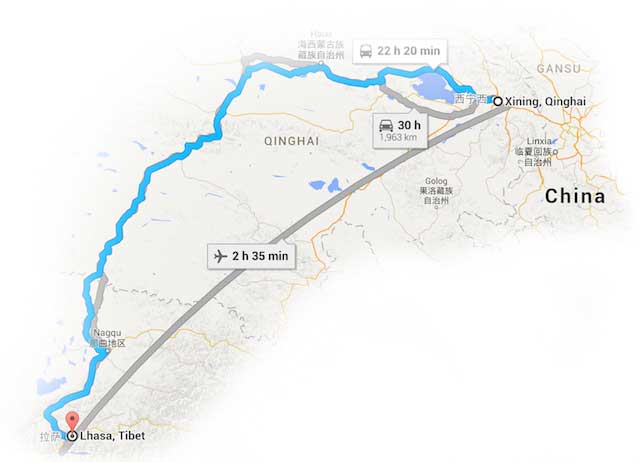
Central Tibet (Tibet Autonomous Region)
Central Tibet is accessible by plane only from Nepal or ports of departure within the PRC. We recommend to get acclimatisations although train travel is 21 hours, as it allows for better acclimatisations. The rail line, built in 2006 boasts modern facilities, sleeping compartments, and dining cars. The port of departure for train travel is Xining, the capital of Qinghai Province. I would also recommend to do a short stay in Amdo by taking a day trip from Xining.
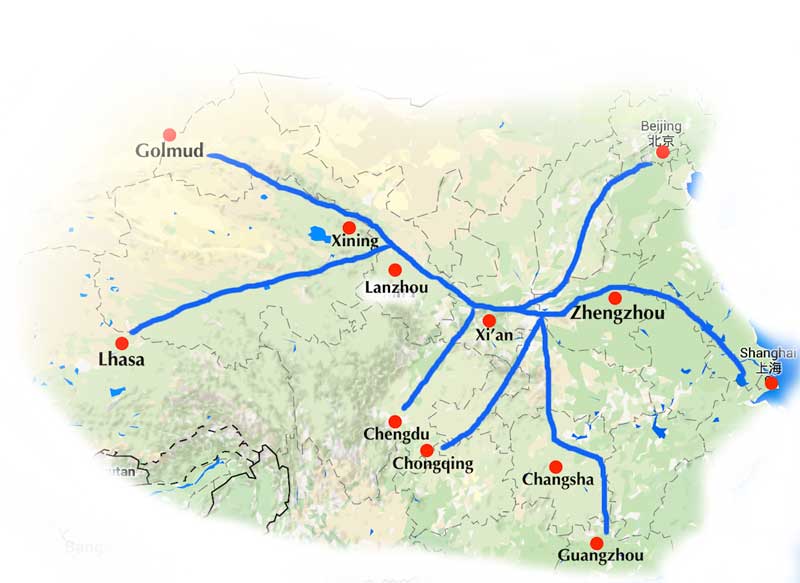
How Do I Get to Kham
Kham is most easily accessible via the capital of Sichuan Province (Chengdu) or the capital of Qinghai Province (Xining). Though Kham is home to a variety of domestic airports, it is best to take overland travel by bus or car is for acclimatisation’s sake. This area is not yet accessible via train.
How Do I Get to Amdo
Amdo is perhaps the most easily accessible area as Qinghai and Gansu’s roadways are comparatively well maintained and the geography is, generally, less vertical. Xining is the gateway to access the bulk of historic Amdo, the capital of Qinghai Province, although it’s southern regions are closer to Chengdu. Many people choose think that it is a great option to do a tour in Amdo.
When should I go to Tibet?
Summer
Generally, the best time for traveling to the Tibetan Plateau is not, contrary to popular opinion, summer. While summer is certainly beautiful, the same monsoon rains that sweep across the Indian subcontinent during the summer (the root of which is the Himalayan mountain range), pour over much of the plateau in the months of June and July. The upside of all the rain is that the flowers of the grasslands are in full bloom. Temperatures are, of course, much warmer during the summer. Check tours in Tibet.
Fall
The late summer or early fall is the time for trekking (particularly late July to late September) if you wish to increase your chances of staying dry. The flowers will be receding at this time, but the rains will have largely stopped.
Winter
Winter is a long affair on the plateau. Lasting from mid-October to early May, it is the coldest time of the year, and even swallowing up that special time we call Spring. While winter is, in many places, bitterly cold, the skies are hauntingly blue and the rivers run turquoise with glacial melt. The sun is typically strong during the day, and as winter is the dry season, one won’t find very many snowy places until middle or late winter or even early spring.
What kind of Visa do I need?
As the areas discussed above are all officially part of the People’s Republic of China, regardless of which region you are interested in visiting, you will first need to obtain a valid Chinese Visa. The exception to this rule is that, if you are entering the Tibet Autonomous Region (TAR) from Nepal, you must instead obtain a Tibet Group Visa from the Chinese Consulate in Kathmandu. Visa cost and processing time will vary depending on country, but it usually takes around 3 working days. The exact permits you will need to procure will vary depending on where you decide to go. Below you can find a rough procedural outline, but please visit our How to visit Tibet page for in depth information, or contact us directly to discuss your exact travel plans and determine what you will need to apply for.
Tibet Autonomous Region (TAR)
When entering the TAR, you must go through a licensed local tour operator to process Tibet travel permit. Under the laws and regulations of the PRCB, it is not permitting backpacking, individual and unguided travels . Before obtaining necessary permits, you can not board train and flights.
To process Tibet travel permit, you are required to send following documentation to your local Tibet travel agency:
- If you enter Tibet from mainland China, You will need to send copies of your Chinese visa and passport:
- If you enter Tibet from Kathmandu, Nepal, you will need to send a copy of the passport.
Kham and Amdo Tibet travel guide
Tibet Travel Permit are not needed for Tibetan cultural areas outside of the TAR, (most of Kham and Amdo). These areas can be visited with most regular, valid, Chinese Visa.
Certain areas in Kham and Amdo are subject to closures and for select areas, visiting or overnight stays may require an Alien’s Travel Permit (ATP )or a Military Permit. Contact us directly to find out if the area you are interested in has special requirements.
Note: To understand all about Tibet travel guide, Tibet Tour agencies are not licensed to assist in issuing you a travel permit if you are employed as a diplomat, journalist, photographer, or government personnel in your country of origin. Persons to whom this restriction applies are only permitted to travel to Tibet with the approval and assistance of The Foreign Affairs Department.
Altitude Sickness
The average altitude of the Tibetan Plateau is over 4,500 meters, so chances are that no matter how good of health you are in, you may experience altitude sickness. Usual symptoms include headaches, dizziness, trouble sleeping, fatigue, and shortness of breathe, and dehydration. In rare and extreme cases altitude sickness can result in edema. Serious altitude sickness is almost always the result of ascending too quickly. A slow ascent and taking rest days to allow for acclimatization are simple steps that can help to make your trip safe and enjoyable. As you ascend in altitude, the air gets thinner and your body begins to overproduce red blood cells to compensate for the decrease in oxygen. Within 72 hours your body will adjust and you can continue to ascend.
Most people will not experience problems with altitude sickness under 2500 meters (8000 feet), but everyone’s body is different. In some cases an increase of even 100 meters can make a big difference. Pay attention to how you are feeling and be ready to take it slow. In addition to altitude sickness, a second common health problem is dehydration. The sun is intensely strong at altitude and drinking lots of water is a must. In terms of infectious diseases, the plateau’s high altitude and cold climate act as a barrier to many lowland vector disease (like Malaria). We recommend that you make sure your vaccination record is current, but region-specific, additional shots are generally not necessary for travel to the Tibetan Plateau.


No comments:
Post a Comment